 (00)
(00)
Aucun produit
Les prix sont TTC

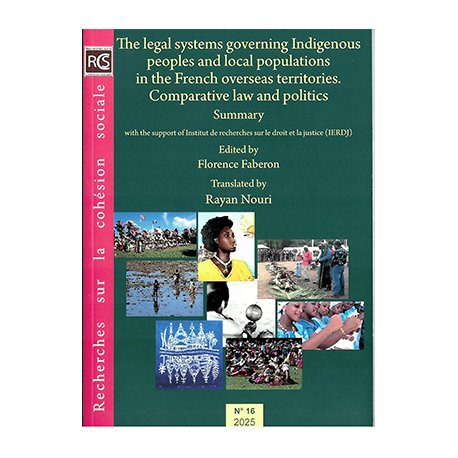

The legal systems governing Indigenous peoples and local populations in the French overseas territories
Comparative law and politics
9782492091193 LESYS
Summary of the proceedings of the symposium on “The Legal Regimes of Indigenous Peoples and Local Populations in the French Overseas Territories,” edited by Florence Faberon.
On 6 July 2023, a conference dedicated to the legal regime governing Indigenous peoples and local populations in New Caledonia was held. Led by public law professors Jean-Yves and Florence Faberon, this study day, organised at the Tjibaou Cultural Centre, made it possible to explore the notion of custom and its evolution over time in New Caledonia from various perspectives. The subject was also placed in a broader context by comparing it with the legal regime of Indigenous peoples in French Guiana, notably thanks to the participation of representatives from that overseas department.
...
Conseils du libraire
Détail produit
| Support | Livre neuf |
| Auteur | Collectif |
| Éditeur | RCS Recherches sur la cohésion sociale |
| Genre | Droit et sciences économiques |
| Date | 2025 |
| Format | Format 14,8 x 21 cm, broché, 126 pages |
| EAN 13 | 9782492091193 |
En savoir plus
The French conception of human rights and the rule of law is rooted in republican universalism. Since the Revolution, democracy has meant that “The law is the expression of the general will. It must be the same for all [...]” (Article 6 of the Declaration of the Rights of Man and of the Citizen).
However, this conception has clashed with certain populations that it has ultimately chosen not to force them into a single mold and chose to respect their distinct identities.
Overseas, this now concerns essentially only four French territories today: French Guiana, Mayotte, New Caledonia, and Wallis and Futuna.
In these regions, the egalitarian French Republic has implemented specific legal systems for Indigenous peoples.
In two of these territories—French Guiana and New Caledonia—the situation is further characterized by the presence of local populations who have been settled there since colonization, alongside Indigenous peopole, the so-colled “first peoples.”
The question of how France undertakes this mission of reconciling divergent perspectives warrants careful analysis, both from the perspective of the territories concerned, and in exploring broader legal and political challenges.
Comparative legal approaches should be drawn upon: How is this handled in ther countries?
How does France, for all its claimed uniformity, actually proceed?
What response do international law and European law offer, particularly in their treatment of human rights?
These two dimensions—specificities and generalities—frame the structure of this work. It articulates its reasoning both based on the legal systems in force, and through the lens of the real living conditions that underpin them.
 Lettre d'informations